Rhamnolipid Market Growth Analysis: Asia Pacific Leads as Green Chemistry Adoption Accelerates
Key Highlights
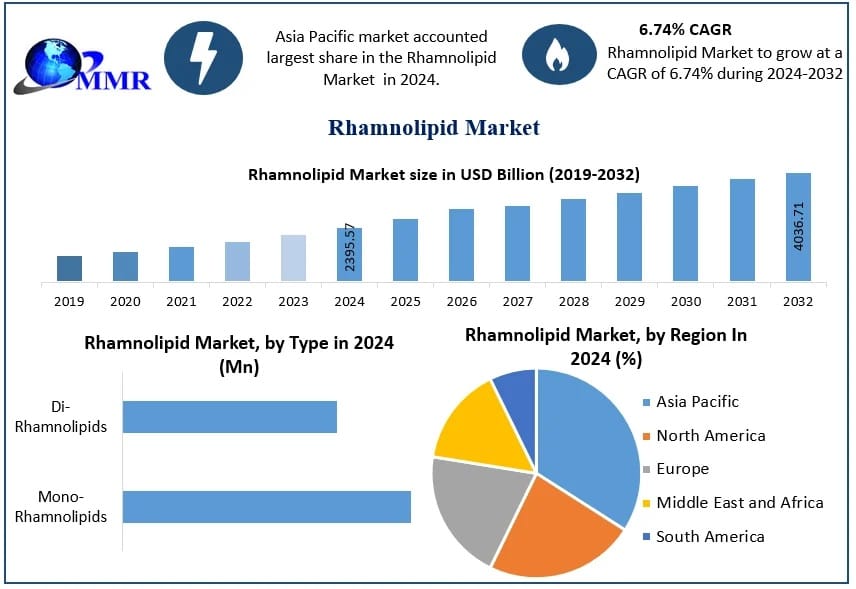
- Global market valued at USD 2,395.57 million in 2024.
- Market projected to reach USD 4,036.71 million by 2032.
- CAGR estimated at 6.74% during 2025–2032.
- Asia Pacific remains the largest regional market.
- Surfactants represent the leading application segment.
- Pharmaceuticals emerge as the fastest-growing application.
- Rising demand for biodegradable chemicals supports adoption.
- Oil recovery and specialty detergents remain major commercial opportunities.
- Cosmetic manufacturers increasingly replace synthetic surfactants with bio-based alternatives.
- High production costs continue to limit broader commercialization.
Why This Matters Now
Industrial buyers are accelerating the shift toward renewable and biodegradable chemicals as environmental regulations tighten and consumer demand for sustainable products grows. Rhamnolipids address multiple industry requirements by combining high-performance surface activity with biological degradability. Their expanding role across pharmaceuticals, cosmetics, detergents, agriculture, and enhanced oil recovery positions manufacturers to reduce environmental impact while improving product performance. Companies capable of scaling production economically will be best placed to capture new commercial opportunities as sustainability becomes a procurement priority.
Market Overview
Rhamnolipids Market are microbial biosurfactants produced primarily by Pseudomonas and Burkholderia species. Their ability to reduce surface tension, emulsify oils, and biodegrade naturally makes them attractive substitutes for petroleum-derived surfactants across industrial applications.
Demand continues to rise as manufacturers pursue environmentally compliant ingredients without sacrificing technical performance. Pharmaceutical companies increasingly incorporate biosurfactants into formulations because of their biocompatibility, while detergent producers seek biodegradable alternatives that satisfy tightening environmental standards. Oil and gas operators also utilize rhamnolipids in enhanced oil recovery and environmental remediation projects to improve extraction efficiency while reducing ecological impact.
Supply conditions remain constrained by relatively high manufacturing costs. Fermentation processes require specialized production infrastructure, making large-scale commercialization more expensive than conventional surfactants. As production technologies improve and economies of scale develop, cost competitiveness is expected to strengthen.
Macroeconomic trends continue to support long-term demand. Expanding pharmaceutical manufacturing in Asia, increasing consumption of bio-based cosmetics, growing crude oil production in the Middle East, and stricter environmental regulations worldwide collectively reinforce market expansion. Temporary disruptions during the COVID-19 pandemic exposed supply chain vulnerabilities but also highlighted the importance of resilient and sustainable chemical supply networks.
Key Trends Driving Growth
Expansion of Bio-Based Surfactants
Industries are replacing synthetic surfactants with renewable alternatives to meet sustainability targets. This transition is creating new commercial opportunities for biosurfactant manufacturers serving personal care, cleaning products, agriculture, and industrial chemicals.
Pharmaceutical Industry Expansion
China and India continue expanding pharmaceutical production due to competitive manufacturing costs and supportive regulatory environments. This increases demand for high-performance biodegradable ingredients used in formulations and specialty applications.
Regulatory Pressure Favors Biodegradable Chemicals
European detergent regulations requiring biodegradable surfactants continue encouraging manufacturers to adopt environmentally compliant alternatives. Regulatory alignment increasingly influences purchasing decisions across developed markets.
Rising Demand from Cosmetics
Growing consumer awareness regarding ingredient safety is driving bio-based cosmetic formulations, particularly in South Korea and Japan. Premium personal care brands increasingly incorporate biosurfactants to strengthen sustainability credentials and product differentiation.
Oil Recovery Applications Expand
Enhanced oil recovery remains one of the most commercially attractive applications. Rhamnolipids improve crude oil recovery through superior emulsification while supporting environmental remediation, creating value for upstream energy producers.
Cost Remains the Primary Constraint
Despite expanding applications, production expenses remain significantly higher than conventional surfactants. Manufacturers investing in fermentation optimization and production efficiency are likely to strengthen competitive positioning.
Explore detailed analysis, insights, and growth opportunities
Segment Insights
Dominant Segment: Surfactants
The surfactants segment accounted for the largest market share in 2024.
Its leadership reflects increasing deployment in enhanced oil recovery, industrial cleaning, detergents, and specialty chemical formulations. Superior emulsification properties improve crude oil extraction efficiency while reducing environmental impact compared with conventional surfactants.
Business impact extends beyond energy markets. Consumer goods manufacturers benefit from biodegradable ingredients that comply with evolving environmental regulations, strengthening product positioning and reducing regulatory risk.
Fastest-Growing Segment: Pharmaceutical
The pharmaceutical segment is expected to record the fastest expansion through 2032.
Rapid growth in pharmaceutical manufacturing across China and India supports higher demand for microbial biosurfactants. Favorable production economics and expanding healthcare investment continue increasing formulation opportunities.
The trend creates attractive opportunities for biotechnology companies specializing in high-purity biosurfactants designed for regulated healthcare applications.
Additional Segment Analysis
By Type
Mono-rhamnolipids and di-rhamnolipids address different industrial performance requirements. Product differentiation allows suppliers to target pharmaceutical, industrial cleaning, and specialty chemical applications with tailored formulations.
By Form
Liquid formulations dominate industrial usage because they integrate easily into manufacturing processes. Powder and ointment formulations support pharmaceutical and specialty applications requiring longer shelf life or controlled delivery.
Agriculture
Agricultural applications continue expanding as producers seek environmentally sustainable solutions that improve soil quality and reduce dependence on synthetic chemicals.
Food Industry
Food manufacturers increasingly evaluate biosurfactants for functional ingredient applications where biodegradability and biological origin provide regulatory and consumer advantages.
Regional Growth Story
Asia Pacific
Asia Pacific represents the largest regional market and is expected to maintain leadership throughout the forecast period.
China, India, Japan, and South Korea drive demand through expanding pharmaceutical production, industrial manufacturing, agriculture, and cosmetics. China remains the leading regional consumer, supported by its large chemical manufacturing base and increasing adoption of sustainable industrial inputs.
Europe
Europe benefits from stringent environmental regulations that encourage biodegradable surfactants. Compliance requirements under detergent regulations continue accelerating substitution away from conventional petroleum-based surfactants, creating stable long-term demand.
North America
North American growth is supported by innovation in biotechnology, specialty chemicals, and sustainable industrial manufacturing. Investments in green chemistry continue expanding commercialization opportunities for advanced biosurfactants.
Middle East & Africa
Growing crude oil production supports increased deployment of biosurfactants in enhanced oil recovery and environmental remediation. Energy-sector demand positions the region as an increasingly important application market rather than solely a production center.
South America
Agricultural production and expanding environmental awareness create emerging opportunities for bio-based surfactants, although commercialization remains at an earlier stage than in Asia and Europe.
Competitive Landscape
The market remains moderately concentrated, with biotechnology specialists competing alongside global specialty chemical manufacturers.
AGAE Technologies has strengthened its competitive position through high-purity product offerings, allowing it to address pharmaceutical and premium industrial applications where performance consistency commands higher margins.
Henkel, Stepan, and Evonik leverage extensive global distribution networks and formulation expertise to integrate biosurfactants into broader specialty chemical portfolios. Their scale supports faster commercialization as customer demand shifts toward sustainable ingredients.
Regional biotechnology companies including Jeneil Biotech, TeeGene Biotech, Allied Carbon Solutions Ltd., Paradigm Biomedical Inc., Lion Corporation, GlycoSurf, TensioGreen, Biotensidon GmbH, and Rhamnolipid Companies, Inc. compete through application-specific innovation and fermentation expertise.
Competitive differentiation increasingly depends on production efficiency, purity levels, regulatory compliance, and the ability to reduce manufacturing costs while maintaining product performance.
Recent Developments
- AGAE Technologies launched a rhamnolipid product portfolio offering 98%, 95%, and 90% purity formulations.
- Logos Technologies introduced the NatSurFact rhamnolipid-based biosurfactant for personal care and household applications.
- Manufacturers continue expanding product portfolios targeting pharmaceutical, detergent, and industrial applications.
- Industry participants are increasing investment in high-purity biosurfactant technologies to improve commercial competitiveness.
Future Outlook
Companies that successfully scale cost-efficient biosurfactant production while meeting increasingly stringent sustainability standards will secure the strongest competitive advantage in the global rhamnolipid market through 2032.
Explore More : Visit our website for Additional reports :
Global Vacuum Pumps Market https://www.maximizemarketresearch.com/market-report/global-vacuum-pumps-market/33082/
Motorcycle Helmets Market https://www.maximizemarketresearch.com/market-report/global-motorcycle-helmets-market/44827/
About Maximize Market Research
Maximize Market Research Pvt. Ltd. (MMR) is a global market research and consulting company that provides reliable, data-focused, and practical business insights. The firm serves a wide range of industries, including healthcare, pharmaceuticals, technology, automotive, electronics, chemicals, personal care, and consumer goods. Through market forecasts, competitive analysis, strategic consulting, and industry impact assessments, MMR helps organizations understand changing market conditions, identify growth opportunities, and make informed business decisions for long-term success.
Contact Us :
2nd Floor, Navale IT Park Phase 3
Pune Banglore Highway, Narhe
Pune, Maharashtra 411041, India
+91 9607365656
sales@maximizemarketresearch.com